The Seven-Compound Stack: What These Peptides Actually Do
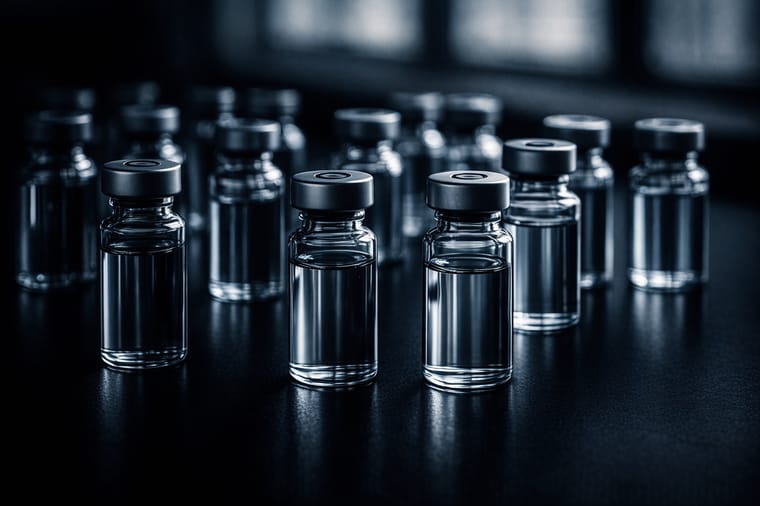
There is a peptide stack circulating in the longevity and recovery communities that keeps showing up in the same conversation: BPC-157, TB-500, KPV, MOTS-C, Emideltide (DSIP), Semax, and Epitalon. Seven compounds, seven different mechanisms, one implicit promise — that together they do something a single supplement cannot.
Before reaching for that promise, it is worth understanding what each of these actually is.
The Tissue Architects
BPC-157 (Body Protection Compound-157) is a synthetic pentadecapeptide derived from a protein found in human gastric juice. It does not belong to any natural peptide family — it was engineered. In animal studies, it accelerates healing of tendons, ligaments, muscle, and gut lining with unusual consistency. The proposed mechanism involves upregulation of the growth hormone receptor and stimulation of nitric oxide production, which drives angiogenesis — the formation of new blood vessels into damaged tissue.
The clinical research is limited. Almost all of the compelling data comes from rodent models. But the effect sizes in those models are large enough — and consistent enough across tissue types — that it has attracted serious attention outside the biohacking community. The gut-healing angle in particular is being studied in the context of IBD and NSAID-induced damage.
TB-500 is a synthetic version of Thymosin Beta-4, a naturally occurring peptide found in nearly every cell in the human body. Its primary role is actin regulation — specifically, binding to G-actin to influence cytoskeletal dynamics. In practice, that translates to cell migration, wound healing, and tissue regeneration. Where BPC-157 appears strongest in tendon and ligament repair, TB-500 shows broader activity across cardiac, neural, and muscular tissue. The two are often stacked together on the assumption that their mechanisms are complementary rather than redundant.
The Anti-Inflammatory
KPV is a tripeptide — just three amino acids: lysine, proline, valine — derived from the C-terminal end of alpha-MSH (alpha-melanocyte-stimulating hormone). It is striking how much anti-inflammatory activity has been attributed to something this small. The mechanism runs through MC1R (melanocortin-1 receptor) and NFκB inhibition. In gut research, KPV has shown meaningful effects on colitis models. It is also being explored for skin inflammation and wound healing.
Because of its small size, oral bioavailability is a live question — small peptides are more resistant to digestive degradation than large ones, which makes the oral route more plausible here than for compounds like BPC-157.
The Mitochondrial Regulator
MOTS-C is the outlier in this list. It is not a synthetic compound — it is encoded in the mitochondrial genome, which means it is produced inside the mitochondria themselves. That alone makes it interesting from a first-principles standpoint. It acts as a metabolic regulator: activating AMPK, improving insulin sensitivity, and enhancing mitochondrial efficiency. Studies in mice show improved exercise endurance and protection against age-related metabolic decline.
The translation to humans is early. But the mechanism is plausible enough that it is being studied seriously in the context of type 2 diabetes and metabolic aging, not just by biohackers.
The Sleep Architecture Compound
Emideltide — more commonly known as DSIP (Delta Sleep-Inducing Peptide) — is a naturally occurring neuropeptide first isolated from rabbit cerebrospinal fluid in the 1970s. The name is literal: it was discovered by its ability to induce slow-wave sleep in animals. The mechanisms extend beyond sleep into stress response modulation, cortisol regulation, and hypothalamic-pituitary axis activity.
The research is old and uneven. Some studies show clear sleep-stage effects; others show modest results. It remains interesting for its specificity — this is not a sedative, it is a sleep architecture modulator — but clinical translation has been inconsistent.
The Cognitive Enhancer
Semax is a synthetic heptapeptide derived from ACTH (adrenocorticotropic hormone). It was developed in Russia in the 1980s, and remains more widely used and studied in Russian medical literature than in Western research. Its primary mechanism involves BDNF (brain-derived neurotrophic factor) upregulation — BDNF is the growth factor most closely associated with neuroplasticity, learning, and recovery from neurological injury.
Semax has been used clinically in Russia for stroke recovery and cognitive impairment. The self-reported effects in healthy users tend to cluster around working memory, focus, and mental clarity under stress. The underlying mechanism is legitimate. The human trial data is thin by Western standards, but not absent.
The Epigenetic Clock Target
Epitalon (Epithalon) is a tetrapeptide derived from Epithalamin, a polypeptide extract from the pineal gland. Its mechanism is the most ambitious claim in this list: activation of telomerase, the enzyme that maintains telomere length. Telomere shortening is one of the hallmarks of cellular aging. If Epitalon actually stimulates telomerase activity in somatic cells, it is targeting aging at a mechanistic level.
The research was conducted primarily by Vladimir Khavinson at the St. Petersburg Institute of Biogerontology, and the claims are significant — extended lifespan in rodents, improved immune function in elderly humans, normalized circadian rhythms. The scientific community has been cautious: the studies are real but the replication is limited, and telomerase activation in somatic cells carries its own theoretical risks (the same mechanism that extends cellular life also underlies certain cancers).
What This Stack Actually Represents
Taken individually, each of these compounds has a coherent mechanism and at least some credible evidence. Taken together, they represent something unusual: a stack designed not around a single outcome — more muscle, less fat, faster recovery — but around the underlying biology. Tissue repair, mitochondrial function, inflammation control, sleep quality, neuroplasticity, epigenetic aging. The full stack.
The honest framing is that most of the human evidence is thin, most of the animal evidence is compelling, and the risk profiles — while not zero — are generally considered low for the peptides in this class. These are not anabolic steroids. They are not stimulants. Most of them are mimicking or amplifying mechanisms that already exist in the body.
The harder question is whether stacking seven compounds with seven different mechanisms is synergistic, additive, or just complicated. Biology does not always reward maximalism. But as a map of the biological territory these compounds cover, the stack is at least coherent — and for someone thinking seriously about the underlying mechanisms of recovery and longevity, it is worth understanding what each piece is actually doing.